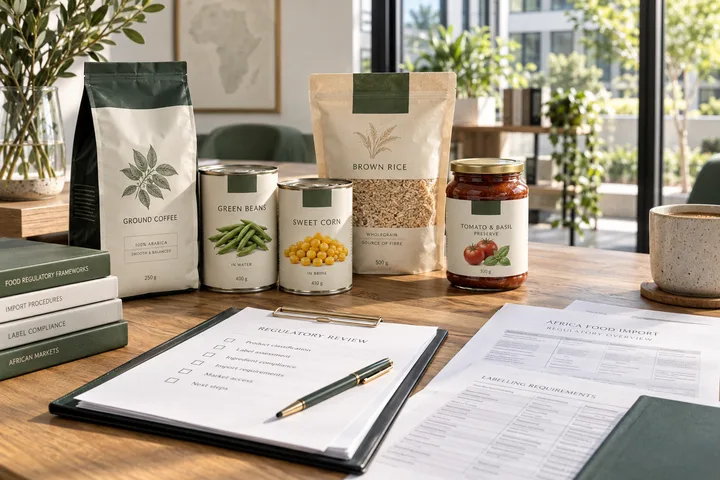
Regulatory sources and application framework
For this country, research competent food or standards authority sources alongside the importer’s product category and local sales plan. Neighbouring-country packaging or regional trade arrangements do not establish acceptance of the same label. Verify the current local text and required language; identify registration, analysis or document requests that constitute separate processes.
PRODUCT REVIEW IN PRACTICE
Ethiopia: product dossier priorities
For Ethiopia, the review scope changes for plain, flavoured or blended coffee. Obtain producer records supporting roast and origin descriptions and check supplied Amharic or other-language wording against the technical dossier.
First step: product and sales scope
The review does not start with artwork alone. Establish the full product name, form, intended consumer, sales channel and pack sizes. Ready-to-eat and prepared products may require different information bases. Define retail packs, catering containers, samples and bulk goods intended for repacking separately.
Consider ordinary food, supplements, infant products or other special categories early. Classification affects source selection and documentary needs. Record recipe codes alongside artwork so the manufacturer, importer and design team work from the same version.
Which label fields are reviewed?
Include the descriptive name, ingredient sequence, compound ingredients, allergens, quantity, date, lot, storage and usage in the review matrix. Confirm which fields are mandatory and their presentation for the destination and product. Assess small-pack text space, information covered by supplementary labels and online product imagery together.
Match nutrition declarations to recipe, calculation or analytical evidence. Distinguish serving and per-100-g or per-100-ml bases, prepared and dry values, units and rounding approaches. Review front claims and product imagery too; an accurate ingredient list does not automatically substantiate other marketing statements.
Language versions and technical meaning
Compare client-supplied local text side by side with original producer information. Report missing sub-ingredients, allergens or storage wording between languages. Flag terms needing a language specialist. The work evaluates existing labels; define new design or translation production separately if required.
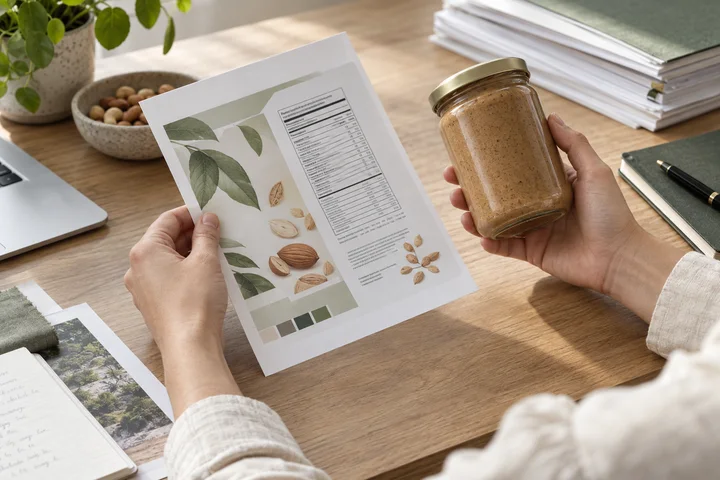
Starting dossier: documents and evidence
The starting set includes legible artwork showing every face, current recipe, product specification and supplier allergen information. Identify the analysis or calculation supporting nutrition values. Add records for shelf life, storage, origin and claims. Keep missing product codes or dates explicit in the final report.
Request importer product forms, sales channels, supplementary label drafts and any authority correspondence. Do not assume every document is mandatory for every food; establish requirements after product and country research. Ask the producer to resolve conflicting supplier evidence instead of closing it by assumption.
Report, corrections and pre-print review
Deliver annotated artwork, an actionable correction list and the sources used together. Each finding identifies the affected surface, technical reasoning, expected evidence or proposed action. Separate open questions from completed checks; items awaiting a local contact are not presented as concluded compliance findings.
Compare revisions implemented by the design team again. Check for reverted allergen text, the wrong country file reaching print or a new pack size carrying an old nutrition panel. Reassess the previous report’s scope when recipes, suppliers or destinations change. The deliverable is a technical assessment and does not replace an authority’s permission or approval.
Label review: evidence and findings table
| Review scope | Evidence reviewed | Report output |
|---|---|---|
| Product name and class | Recipe, product form, intended use | Correct sources and review scope |
| Ingredients and allergens | Sub-ingredients, supplier and cross-contact records | Comparison of label text and evidence |
| Nutrition and claims | Analysis or calculation, serving, front wording | Data basis and claim evidence |
| Language and layout | Every face, local wording and supplementary label | Missing-information and readability findings |
| Import and traceability | Importer, lot, dates and shipment version | Document needs and local confirmation questions |
Questions about the country review
Can an existing label be used in Ethiopia?
First compare product class, language, sales channel and every label face. Packaging used in another country is not evidence of suitability here on its own. The report separates reusable fields from information requiring changes.
Is importer acceptance sufficient for the review?
Importer knowledge is an important input. Still, review packaging, producer evidence and applicable source texts together. Clarify verbal requests in writing against a specific product and version before adding them to the dossier.
When should the review be renewed?
Recheck the previous scope when recipes, suppliers, nutrition data, pack sizes, local wording or sales countries change. Regulatory changes may also require a new assessment. Identify the reviewed file version explicitly in the report.
Sources and research method
These links are research starting points. FAOLEX provides access to national texts; not every archived text is current law. Codex is an international reference and is not treated as binding national law without verifying adoption. Identify the competent authority, applicable version and transitional provisions again for every product assignment.